Solar Panel Price Philippines 2026: Costs and Payback
What solar panels and home systems cost in the Philippines in 2026: price by size and monthly bill, add-ons, installer types and payback.
A solar panel in the Philippines costs about ₱5,900 for a 625W panel from a Tier 1 maker like Canadian Solar. But a panel is only one part of a working system. A full home system starts at ₱177,728 and can go up to ₱520,511 for a ₱10,000 monthly bill, depending on the package you pick. The final price depends on system size, roof and add-ons.
What is inside a solar system price?
A solar system price pays for much more than panels. Panel wattage keeps rising every few months, so the models on sale change often. A system also needs an inverter, mounting, wiring, net metering and labor.
Here is where the money goes in Blueshift's budget package for a ₱10,000 bill, as of October 2026:
| Part | Share of price before VAT |
|---|---|
| Panels, mounting and wiring | 53% |
| Inverter | 16% |
| Net metering | 31% |
VAT is 12% on top of that.
How much does a solar system cost by size?
A home system costs between ₱177,728 and ₱886,279 depending on your bill and package. We name the three packages minimal, budget and maximize. In the tool they appear as Getting started, Impact you can feel and Maximize.
These are estimates for a house with a metal roof, daytime use, net metering and VAT included, as of October 2026. They are what we would quote, not what clients paid.
| Monthly bill | Package | System size | Price | Price per kWp | Saves a month | Payback |
|---|---|---|---|---|---|---|
| ₱10,000 | Minimal | 2.58 kWp | ₱177,728 | ₱68,887 | ₱4,072 | 3.6 years |
| ₱10,000 | Budget | 3.23 kWp | ₱291,070 | ₱90,254 | ₱5,241 | 4.5 years |
| ₱10,000 | Maximize | 8.39 kWp | ₱520,511 | ₱62,076 | ₱10,493 | 4.1 years |
| ₱20,000 | Budget | 5.81 kWp | ₱397,261 | ₱68,434 | ₱9,534 | 3.4 years |
| ₱20,000 | Maximize | 16.13 kWp | ₱886,279 | ₱54,963 | ₱20,354 | 3.6 years |
Smaller systems cost more per kWp. Fixed costs like permits and mobilization get spread over fewer panels.
Your savings also depend on when you use power. On a ₱10,000 bill, the budget package saves ₱5,241 a month with daytime use and ₱4,711 with night-heavy use.
How much does a net metering add-on cost?
A net metering add-on costs ₱77,500 before VAT, or ₱91,140 with VAT and mobilization. Net metering lets you send extra power to Meralco and get credit for it. Read more in our net metering guide.
Our add-on covers the paperwork and the extra wiring Meralco requires. It also comes with a guaranteed pass.
How much does a solar battery cost?
A solar battery adds ₱14,449 to ₱131,089 to a quote, depending on size and bill. Our list prices are ₱72,500 for a 5.12 kWh Dyness battery and ₱151,747 for a 16.08 kWh PowerBrick Max.
The add-on can be lower than the list price because a battery can reduce the panels and inverter you need. A battery also raises your savings per panel. Net metering credits the power you send to the grid at a lower rate than the grid charges you. A battery lets you use your own solar power when you need it, so each panel saves you more.
What is the difference between kWp and kWh?
kWp is how much power your panels can make at their best. kWh is how much energy you use or store over time.
Why do solar prices vary?
Solar prices vary because systems differ in size, equipment, roof, battery and who does the work. A cheap quote often leaves out parts that another quote includes. Always compare what is inside the price.
What size solar system do I need?
The right size depends on your monthly bill, when you use power and your roof. A ₱10,000 bill fits anything from 2.58 kWp to 8.39 kWp, depending on how much of your bill you want to cut. With 625W panels, that is roughly 5 to 13 panels.
Not sure what fits you? Try the Solar Design Studio. It simulates a design for your own roof.
What does a solar system price include?
A Blueshift price covers the panels, inverter, mounting, wiring, net metering and mobilization, plus 12% VAT. It also covers a 5 year workmanship warranty, a production guarantee, active monitoring and 1 year of Blueshift One.
A cheaper quote may leave some of these out, so ask for the full list.
Does solar get cheaper per watt as it gets bigger?
Yes. Price per kWp drops as the system grows because fixed costs are spread over more panels. A 2.6 kWp home system is about ₱68,900 per kWp. A 31 kWp system is about ₱51,100 per kWp.
| Residential system | Price per kWp |
|---|---|
| 2.6 kWp | ₱68,900 |
| 9.0 kWp | ₱62,100 |
| 16.1 kWp | ₱55,000 |
| 31 kWp | ₱51,100 |
These are estimates from our Solar Design Studio as of October 2026, VAT included.
How much does commercial solar cost?
Commercial solar costs about ₱38,900 to ₱42,600 per kWp for systems from 24.5 to 99.3 kWp. Businesses pay less per watt than homes because larger systems tend to cost less per watt than smaller ones. See our commercial solar page.
Is solar cheaper than Meralco?
Yes. Meralco costs about 5 times more per kWh than solar. Solar costs about ₱2.99 per kWh over its life. Meralco's overall residential rate is ₱14.74 per kWh as of September 2026.
That ₱2.99 is the levelized cost of energy, or LCOE. It is the total cost of the system divided by all the kWh it makes. Our figure covers 30 years, with 1% degradation in year one and 0.4% a year after that. It assumes 1,300 kWh per kWp a year, which is on the high side for Metro Manila.
Meralco's rate can change every month. The latest figure comes from Meralco's September 2026 rate advisory.
Solar prices by installer type
There are three kinds of installers: self-installers, mid-tier installers like Blueshift, and premium installers. We collected 34 quotes for Metro Manila homes in January and September 2026. Each dot in the chart is one quote.
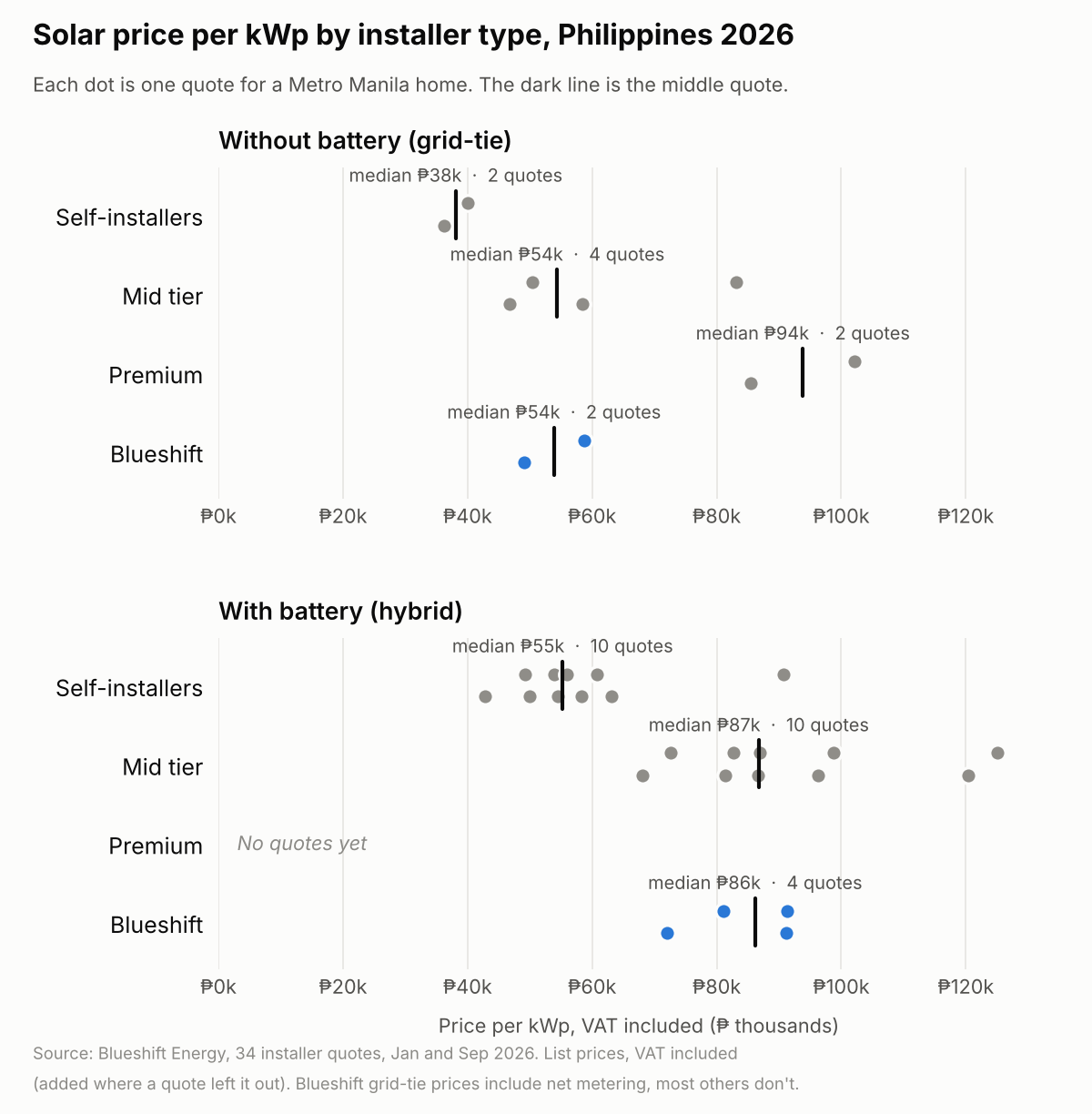
With a battery, self-installers asked a median of ₱55,300 per kWp. Mid-tier installers asked ₱86,800, and Blueshift's median was ₱86,200. Battery sizes ran from 5 to 43 kWh, so compare quotes with the same battery size.
Without a battery, premium installers start at ₱85,500 per kWp and can go up to ₱102,200. On the same 10 kWp home, that was 1.7 to 2.1 times our price. Self-installers start at ₱36,200 and can go up to ₱40,000. Mid-tier installers start at ₱46,700 and can go up to ₱83,100. Our grid-tie prices include net metering, and most others don't.
| Installer type | Without battery | With battery |
|---|---|---|
| Self-installers | ₱36,200 to ₱40,000, 2 quotes | ₱55,300 median, ₱42,700 to ₱90,700, 10 quotes |
| Mid-tier installers | ₱54,400 median, ₱46,700 to ₱83,100, 4 quotes | ₱86,800 median, ₱68,000 to ₱125,000, 10 quotes |
| Premium installers | ₱85,500 to ₱102,200, 2 quotes | No quotes yet |
| Blueshift | ₱49,100 to ₱58,700 with net metering, 2 quotes | ₱86,200 median, ₱72,100 to ₱91,400, 4 quotes |
Prices are per kWp, list prices, VAT included.
Ask every installer if the quote includes VAT. Many installers quote without it. Blueshift prices include VAT.
What you get also differs between the types:
| What you get | Self-installers | Mid tier | Premium | Blueshift |
|---|---|---|---|---|
| 24/7 active monitoring | No | No | No | Yes |
| Free first year of O&M, called Blueshift One | No | No | No | Yes |
| Simulated design | No | No | No | Yes |
| Production guarantee | No | No | No | Yes |
| PCAB license | No | No | Yes | Yes |
| Workmanship warranty | About 1 year | Mostly 1 year | 5 to 10 years | 5 years |
| Inverter warranty | Mostly 5 years | Mostly 5 years | 5 to 10 years | 5 years, extendable to 10 |
Blueshift's price sits close to mid-tier installers, but you get things even premium installers don't have. That means 24/7 active monitoring, a free first year of O&M, a simulated design and a production guarantee. Warranty terms are in the table too.
Is solar worth it in the Philippines?
Yes, if the savings beat what you would earn by leaving the money elsewhere. On a ₱10,000 bill, the budget package saves ₱5,241 a month on a ₱291,070 system. That is about 21.6% of the price back each year. The maximize package returns about 24.2% a year.
Payback runs from about 2.9 to 5.5 years across our packages.
Is a solar loan worth it?
Our installment plan takes 20% down, then charges 17% a year for up to 36 months. Here is the honest monthly math for the budget package:
| Item | Amount |
|---|---|
| System price | ₱291,070 |
| Down payment, 20% | ₱58,214 |
| Estimated monthly installment, 36 months | about ₱8,200 |
| Monthly savings | ₱5,241 |
For the first three years, the installment is higher than your savings, by about ₱2,900 a month. After that, you keep the full savings. Pay cash if you can. Use the installment if you want to start now and spread the cost.
Want to pay in installments? Talk to us about installment plans.
Frequently asked questions
How much is a 5kW solar system in the Philippines?
A 5.81 kWp system costs about ₱397,261 for a ₱20,000 monthly bill, as of October 2026. Smaller systems cost less in total but more per kWp.
How many solar panels do I need for a ₱10,000 bill?
About 5 to 13 panels of 625W, depending on the package. The budget package is 3.23 kWp and the maximize package is 8.39 kWp.
Is a solar battery worth it?
A battery is worth it if you have frequent blackouts or use power at night. It adds ₱14,449 to ₱131,089 to a quote. Night-heavy use saves less, about ₱4,711 a month versus ₱5,241 for daytime use on the budget package.
How long is the payback of solar?
Payback runs from about 2.9 to 5.5 years across our packages, based on our Solar Design Studio estimates.
Can I pay for solar in installments?
Yes. We take 20% down and charge 17% a year over up to 36 months.