
Net Metering Philippines Complete Guidelines 2026
How net metering works in the Philippines, what Meralco pays for exported solar, the requirements, the real 3 to 8 month timeline, and whether it's worth it.
Net metering in the Philippines lets solar owners send extra power back to the grid and earn credits that lower their electric bill. With electricity rates always moving, it sounds like an obvious choice. However, navigating strict technical standards, city hall clearances, and the step-by-step Meralco application process stops many homeowners and business owners in their tracks.
This guide breaks down the real timelines, engineering requirements, and local government bottlenecks on the ground so homeowners and business owners can decide if the return on investment justifies the effort.
What is Net Metering and How Does It Work?
Net metering is a program that lets homes and businesses with solar setups up to 100 kW (kilowatts) export extra power to the grid and earn credits on their bill.
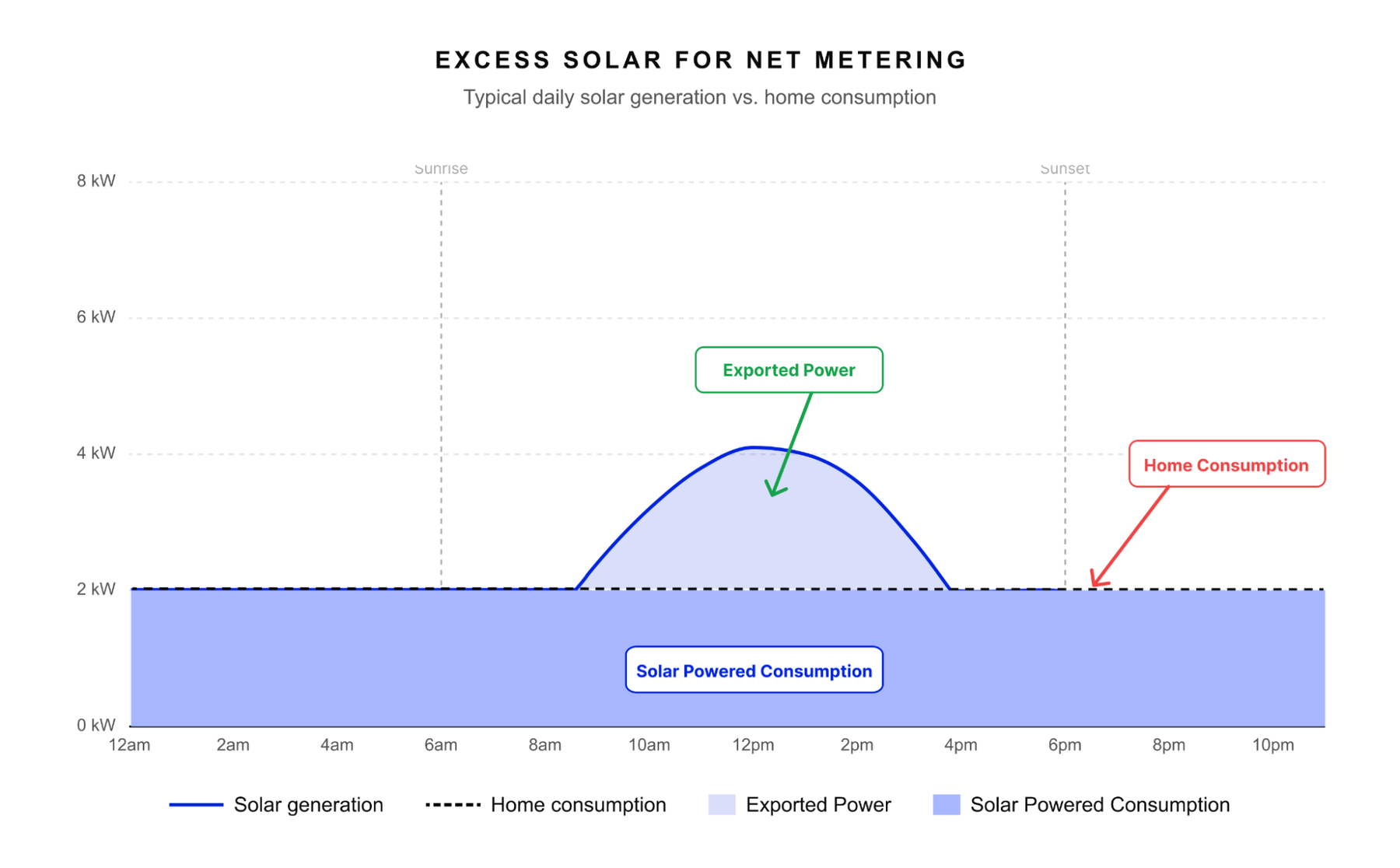
When rooftop solar panels produce more electricity during the day than your property needs, the excess power is automatically exported to the utility grid. The local distribution utility then credits the account for that exported energy, directly lowering your next monthly power bill.
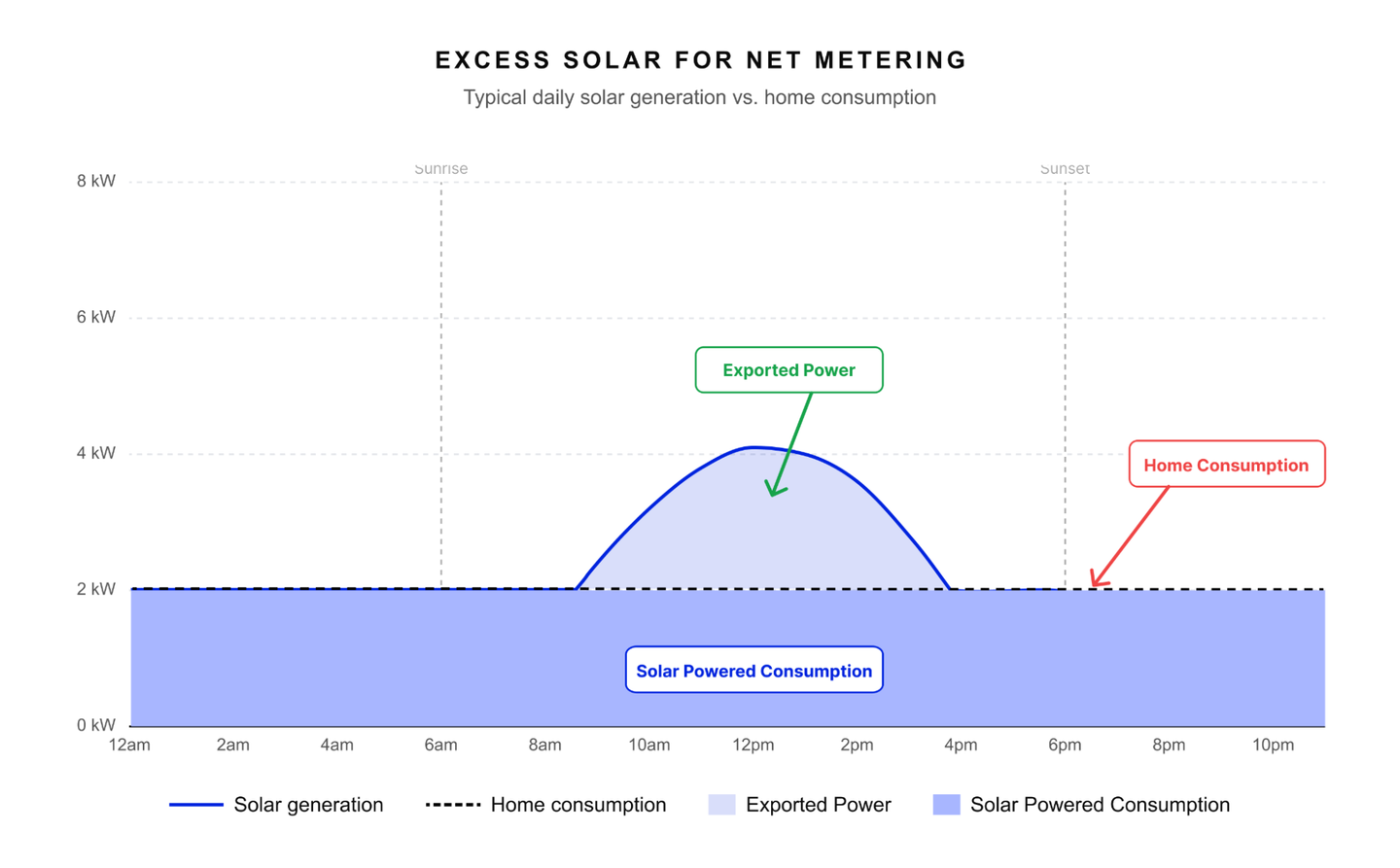
As indicated by this chart on a typical home with mostly night time usage there is a lot of excess electricity during the daytime.
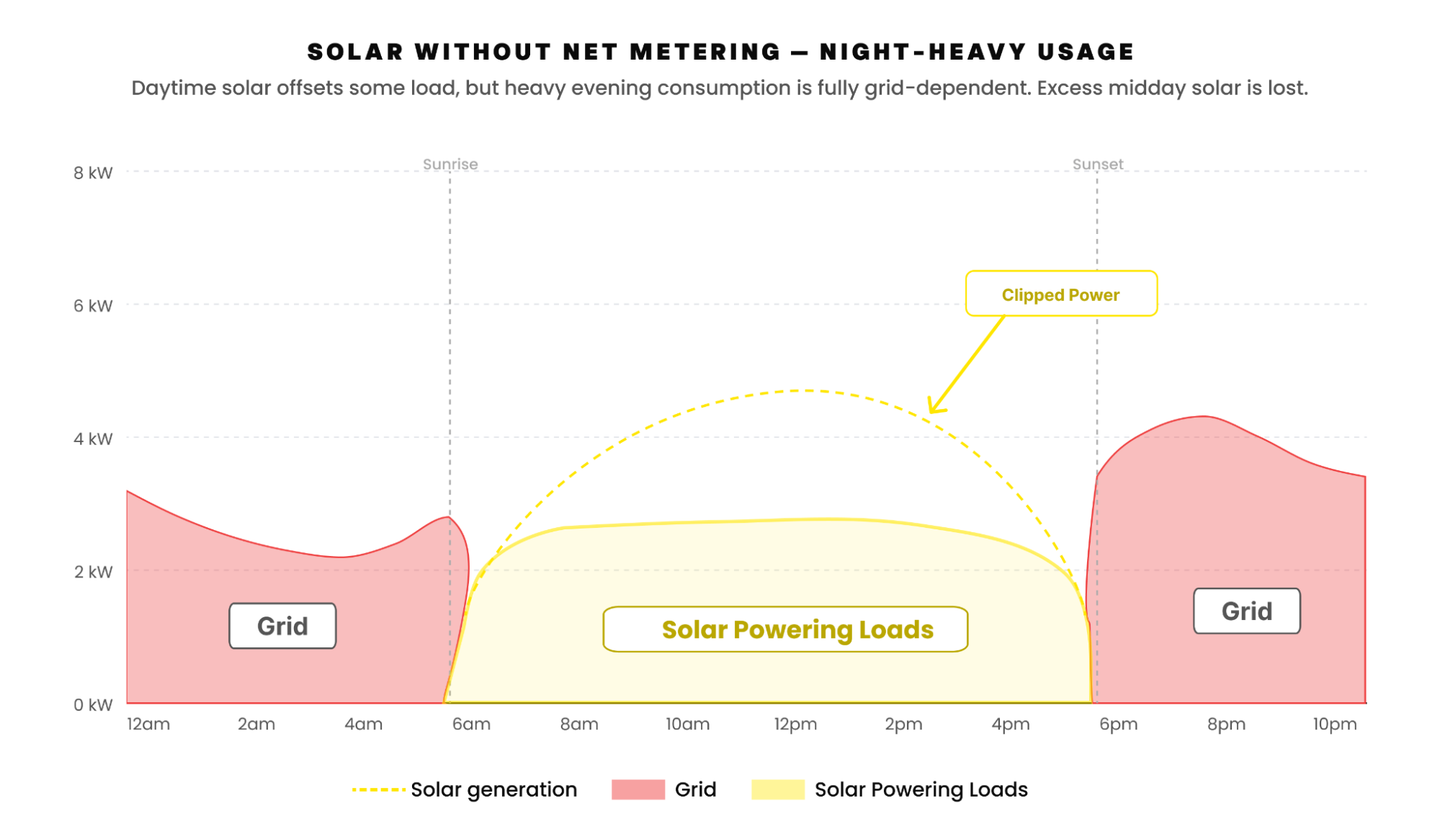
This is what that same chart looks like if the property doesn't have net metering. The program exists because solar production naturally peaks under the midday sun, right when your property's real-time baseline usage often dips. This mismatch creates an immediate surplus of power, which is why properly sizing a solar system is critical. Systems are engineered to fit each unique home's usage or business consumption so property owners never over-invest in dead capacity.
System Size Limitations
Net metering is capped at 100 kW per system under RA 9513. The law itself doesn't specify if that's DC (panel capacity) or AC (inverter output) and this matters because you can oversize your panels relative to your inverter. We've talked to multiple distribution utilities, and they've confirmed it's DC capacity, meaning the solar panel capacity, not the inverter.
The Net Metering Buyback Rate
The net metering buyback rate is the utility's generation rate, not the full retail price. On Meralco's September 2026 schedule, that is ₱9.7032 per kWh. This rate changes every month and leaves out transmission, distribution, taxes, and other charges. Because power is purchased at retail rates but exported at wholesale value, the proposals factor in this lower generation rate to give an accurate savings projection. See exactly how these credits apply by looking at a Meralco bill breakdown and its generation rate charges, which reveals precisely what solar can and cannot eliminate from your monthly bill.
Earn Bill Credits
Local distribution utilities track excess export and credit the account for that energy, directly lowering the next monthly power bill.
For example, using Meralco's September 2026 rates:
- Total consumption: 2,000 kWh × ₱15.9734 (all-in residential rate, VAT included) = ₱31,946.80
- Total export: 1,500 kWh × ₱9.7032 (generation rate) = ₱14,554.80
- Net payable: ₱31,946.80 − ₱14,554.80 = ₱17,392
The ₱15.9734 all-in rate adds up every per-kWh charge on Meralco's September 2026 schedule, plus VAT, fixed charges, and energy tax, for a home using 2,000 kWh. Local franchise tax varies by city and is not included. This consumption figure already reflects solar covering part of the property's usage. Without solar, the bill would be higher.
For commercial clients, there's a common misconception that their per-kWh rate is also high. In reality, the summary at the front of a commercial bill breaks down into several components, including demand (kW) charges, which solar does not reduce and kWh charges, which solar does offset. Because of this, net metering on commercial properties can deliver close to a 1:1 value on the kWh portion of the bill.
Credit Banking
Credit banking lets owners carry excess solar credits forward across current and future billing periods, so they don't expire every year. Build them up early, and when the time comes to add a big new load like an EV or plug-in hybrid, there's a reserve of banked credits ready to absorb the extra consumption.
Banked credits also stay with the property. If the home is sold or the Meralco account is transferred to a new owner, the accumulated credits and the Net Metering Agreement carry over with it, since they're tied to the physical facility and its service account, not to the individual owner.
This is a recent change. Under the 2025 Amended Net-Metering Rules (ERC Resolution No. 15, s. 2025), credits roll over instead of resetting to zero at year-end like they did under the old framework.
Is Net Metering Worth It?
Yes, for most properties. Net metering typically pays back its processing cost in 3 to 6 years, based on what Blueshift sees across its clients. The panels carry a 30-year performance warranty, so after payback, every exported kWh is extra savings for decades.
It Lets the Battery Be Sized Right
Solar output swings hard by season. Production is strong in the dry months and weak in the rainy season. Without net metering, no battery size works all year. Size it for summer and it sits half-empty when the rains come. Size it for the rainy season and the extra summer energy goes to waste.
Net metering fixes this. The battery can be sized for the rainy season, so it fills up every day of the year, while net metering takes the summer surplus the battery can't hold. Nothing sits idle. Even with the typical approach, a battery sized for the year's average, the extra-sunny summer days alone still pay back net metering in about 3 to 6 years.
It Covers Vacations and Low-Use Days
Every household leaves home sometimes. While the family is away, the system keeps producing but the property uses almost nothing. Without net metering, that energy is wasted once the battery is full. With net metering, it becomes bill credits that roll over to future months.
Blueshift Handles the Process and the Risk
Most of the hassle of net metering is the paperwork and the chance of failing Meralco's testing. Blueshift handles the whole application, from the Meralco packet to the city hall clearance. For homes, if the system fails net metering testing, Blueshift installs a harmonic filter so it passes the re-test, covered by the processing fee. For commercial sites, energy monitoring shows the power quality before design, so there are no surprises. See the Blueshift net metering guarantee below.
Not Sure Yet? Let the Data Decide
Owners who aren't ready to commit don't have to guess. Blueshift Active Monitoring, free for the life of the system, tracks how the property actually uses and exports power, and flags whether net metering is worth adding based on that data.
For commercial clients, the answer comes before design even starts. Blueshift runs free 2-week energy monitoring first. A meter goes on the main panel with no downtime and takes readings every 5 minutes, which checks grid compliance for net metering and finds extra ways to save before solar.
Every property is still different. One client draws power mostly at night, another only on weekends, another has a chunk of morning usage before everyone leaves. Each of those shapes changes how much solar is self-consumed versus exported, and that ratio is what sets the real payback. This is what Solar Design Studio is built to solve. It simulates a specific property's real load profile against local weather data and the actual system config, so owners can see whether net metering pays for itself for their setup, not a generic average.
Energy Storage With Net Metering
Batteries and net metering work together, and the right balance comes down to a single tradeoff: the bigger the battery, the less net metering matters, and the smaller the battery, the more valuable net metering becomes.
The reason is the gap between what a property pays for power and what the grid pays back. Net metering credits exports at the generation rate, ₱9.7032 per kWh, because it leaves out transmission, distribution, and taxes. A battery, by contrast, lets the property keep that energy and use it at night, offsetting the full residential rate of around ₱15.97/kWh with VAT (Meralco rate, September 2026). So every kWh a battery stores and reuses is worth about 1.6 times a kWh exported to the grid.
That's the tension. More battery capacity means more energy captured at full retail value, but also a higher upfront cost, and less reliance on net metering. Less battery means a lower upfront cost, but more surplus spilling to the grid at the cheaper buyback rate, which is exactly where net metering earns its keep. Neither is automatically "right", it depends on the property's load and budget.
Residential vs Commercial
For residential properties, the battery case is straightforward: it turns a ₱9.70 export credit into about ₱15.97 of avoided retail cost. Because that gap is so wide, storage also solves a roof-space problem. A property with limited roof can only fit so many panels, but pairing fewer panels with a bigger battery captures more value from each kWh those panels produce, storing it for full-retail night use instead of exporting it cheaply. A smaller, battery-heavy system on a constrained roof can land near the same monthly savings as a larger panel array, just by squeezing more value out of less generation.
For commercial properties, the logic shifts. The generation charge is the same ₱9.70 per kWh, so on energy alone the battery-versus-export math looks similar to residential. The difference is demand charges (the kW component of a commercial bill), which are billed on peak power draw, not total energy. Solar alone can't reliably reduce demand charges, but a correctly configured battery can, by discharging to shave the peaks. That's a saving net metering and solar simply can't reach on their own, which is why energy storage often makes more financial sense on commercial accounts than residential ones.
The catch: this only works if the storage is configured correctly. A battery that discharges at the wrong time does nothing for demand charges. Getting it right is a sizing and dispatch problem, which is exactly what Solar Design Studio simulates before anything is installed.
Net Metering Requirements
Getting approved for net metering means clearing three sets of requirements: the distribution utility, the city hall, and the physical site itself. On top of the paperwork, your system has to pass a Distribution Impact Study (DIS) that checks how it interacts with the local grid.
It all runs on the same national framework (RA 9513 and the ERC's Amended Net-Metering Rules) no matter which distribution utility serves you, and it happens in a specific order: clear the distribution utility first, that unlocks city hall approval, then return to the utility for final activation. Start to finish, expect a realistic 3 to 8 months on the ground.
We'll use Meralco as the working example since it covers most of Metro Manila and Luzon. If your utility is Pelco, Sfelapco, Veco, DLPC, or another DU, the sequence mirrors this closely. Only the forms and desk change.
Meralco Net Metering Requirements
Meralco's net metering requirements are the 8 documents below, sent in as one application packet, usually by the installer. Once it clears, Meralco issues the yellow card, the electrical safety certification that becomes the key to everything downstream.
The core packet:
- Net-Metering Application Form + Annex
- Latest Meralco bill, full document, front and back
- Transfer Certificate of Title (TCT), proof of ownership
- Two valid government-issued IDs, matching the exact name on the bill
- DPA Consent Statement
- Service Application / Warranty form
- Letter of Intent
- Single-line diagram (SLD), 1 copy for Meralco. The SLD isn't just a wiring layout. It must include the load schedule, voltage-drop and short-circuit calculations, and the specs of the inverter, panels, and battery.
For other utilities, expect the same categories with their own version of the forms.
The DIS: Type I vs Type II
A Distribution Impact Study (DIS) is Meralco's check of how a solar system will interact with the local grid. It has two tracks. Customers can't choose tracks. Meralco assigns it based on system size and how crowded the neighborhood grid is:
- DIS Type I, smaller or straightforward connections. Faster, smoother validation.
- DIS Type II, larger systems or congested grids. Requires an in-depth grid simulation and a Power Quality Analysis (PQA), which adds time.
If a Type II system fails the PQA, it needs a harmonic filter to keep electrical noise within grid-compliant limits. For residential systems, Blueshift's net metering guarantee covers this. Blueshift installs the harmonic filter as part of the processing fee, so the system passes the re-test. For commercial sites, Blueshift's energy monitoring shows the power quality before design, so any harmonic filter is planned into the system from the start.
City Hall (LGU) Requirements
City hall requirements are the documents the local government needs before it issues the Certificate of Final Electrical Inspection (CFEI), the clearance the utility needs before it can activate the system. The process starts once the owner has the yellow card from Meralco.
Every LGU requires the same three core items:
- Yellow card (from Meralco)
- Transfer Certificate of Title (TCT)
- Single-line diagram (SLD), 1 to 2 copies
Beyond those three, each city adds its own paperwork, and this is where it stops being predictable. Some cities want an electrical permit before installation even begins. Others require building permits, occupancy permits, or updated real property tax receipts to issue the CFEI. Cities like Quezon City, Pasig, and Muntinlupa each handle it differently.
On-Site (Physical) Requirements
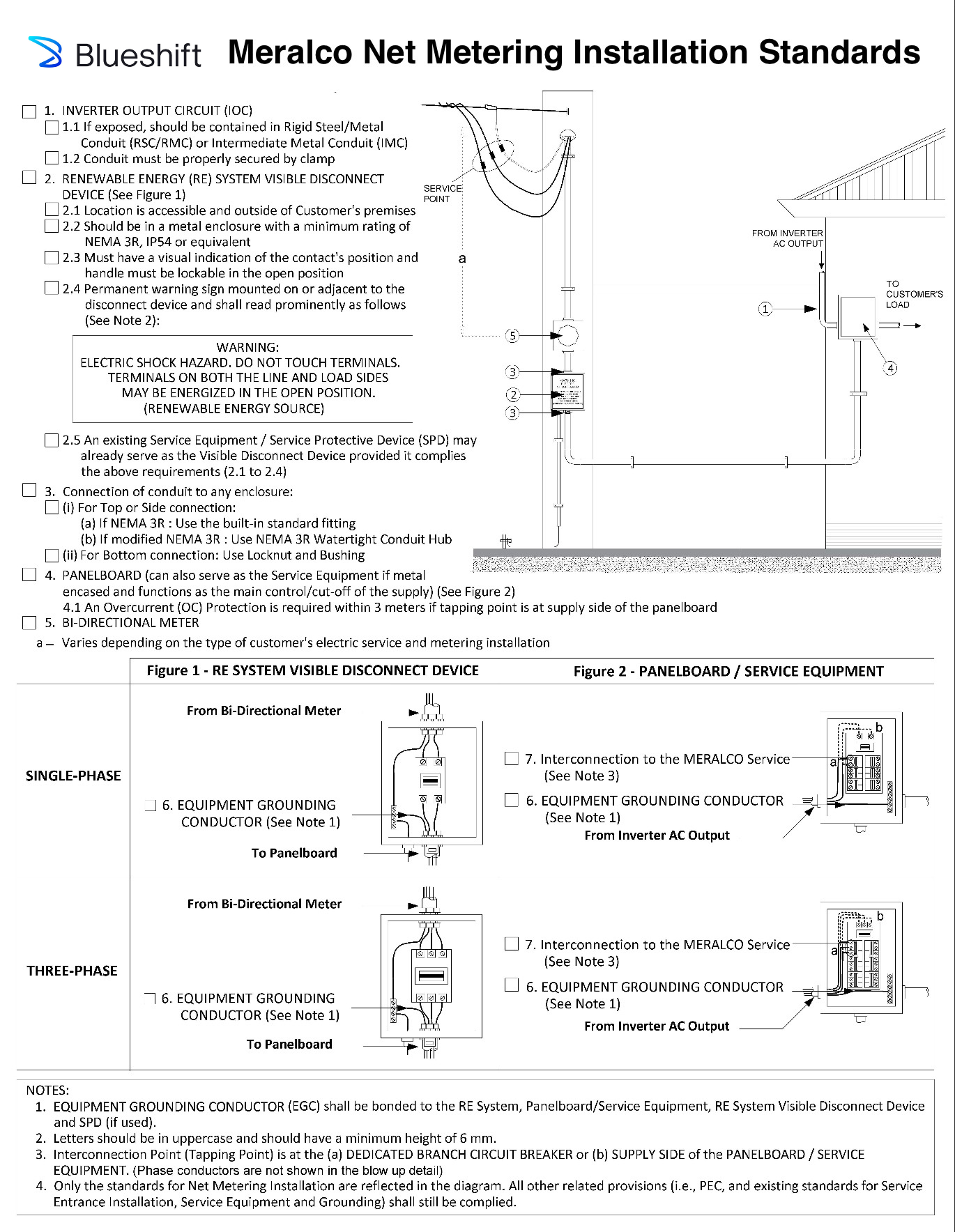
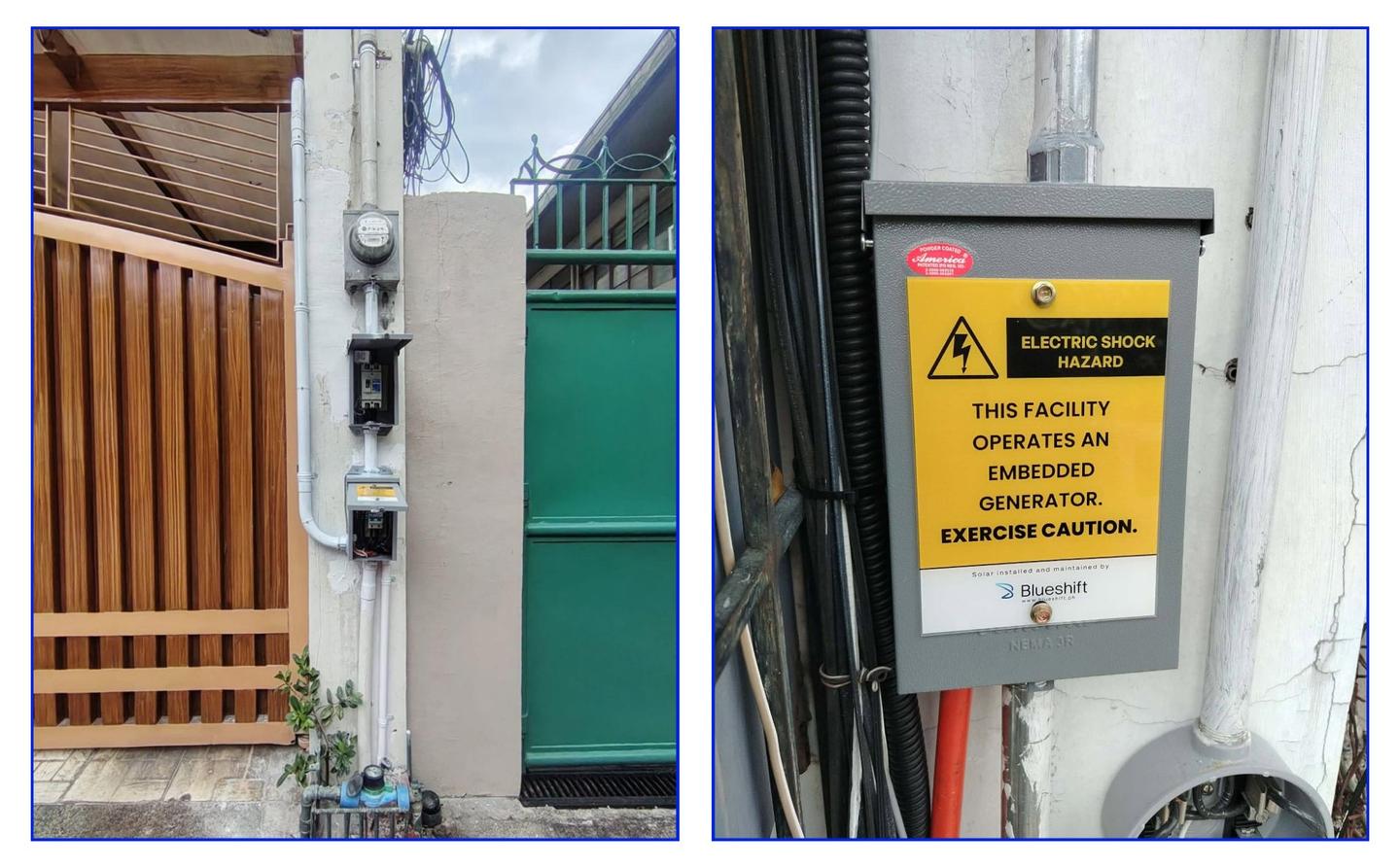
On-site requirements are the physical items Meralco's inspectors check at the property, separate from the paperwork. The site must have:
- A visible PV disconnect, accessible and clearly located on site
- A NEMA-rated warning sticker on the PV disconnect
- IMC or RSC conduit from the inverter AC breakers to the PV disconnect, and critically, this conduit must be exposed and visibly run, not concealed behind walls.
- Anti-islanding functionality, the inverter must shut off instantly during an outage to protect utility lineworkers
Final Activation
Final activation is the last stretch after the CFEI is issued, when Meralco signs the agreement, swaps the meter, and turns on exports:
- Submit the CFEI to Meralco. They issue the Net Metering Agreement (NMA) and a REC meter consent form. Sign the consent if opting out of a REC meter.
- Meter swap. Meralco replaces the old meter with a bi-directional unit.
- On-site anti-islanding test. Field engineers verify the inverter shuts off instantly during an outage.
- Meter reading recorded. Once the test passes and Meralco logs the reading, it is cleared to export. Net metering is live.
- ERC Statement of Account. The ERC issues an SOA under the customer's name. A one-time ₱1,500 fee finalizes the registration.
Timeline of Net Metering
Even with the government's push to speed it up, net metering in the Philippines still takes a realistic 3 to 8 months from contract to activation. That gap is the single most important thing to understand about the timeline.
Under the DOE's April 2026 circular (DC2026-01-00012), issued during the national energy emergency, distribution utilities are required to approve or reject a complete application within 10 working days, and LGUs to issue electrical permits and inspection certificates within 3 working days. There's even a "deemed approved" rule if the utility misses its window. But these deadlines are new, and on the ground they have not been implemented consistently. Utility backlogs, LGU variation, and the physical inspection queue mean the real-world timeline still runs in months, not weeks. This section covers both: the mandated targets, and what actually happens.
| Phase | Real-world time | Mandated target |
|---|---|---|
| Phase 1: Engineering, install and Meralco review | About 2 to 6 months | 10 working days (utility review) |
| Phase 2: City hall clearance (CFEI) | 1 to 6 weeks | 3 working days |
| Phase 3: Final inspection and activation | 1 to 4 weeks | None set |
| Total | 3 to 8 months | A few weeks on paper |
Phase 1: Engineering, Installation & Meralco Review
The system is designed and physically built first: on-site technical inspection, energy-data logging to confirm power quality, initial building permits, and the full installation. Meralco requires the hardware to be 100% built before it will schedule any testing.
In parallel, the application packet goes to Meralco for review. Once it clears, Meralco issues the yellow card. This is also where the Distribution Impact Study (DIS) determines the system's track:
- DIS Type I (smaller or straightforward connections): faster validation, no added studies.
- DIS Type II (larger systems or congested grids): triggers a deeper grid simulation and a Power Quality Analysis (PQA).
- If the PQA passes: the system proceeds to Phase 2 normally.
- If the PQA fails: the system needs mitigation, typically a harmonic filter, before it can pass. For residential systems, Blueshift's net metering guarantee covers the harmonic filter as part of the processing fee, so a Type II failure doesn't add expense. For commercial sites, energy monitoring flags power quality issues before design.
Average added time for Type II: 2-4 Weeks. Max: 2-3 Months.
Phase 2: City Hall Clearance (CFEI)
With the yellow card in hand, the paperwork moves to the local city hall for the Certificate of Final Electrical Inspection (CFEI). This is the step that varies most by location. Every LGU has its own requirements and pace, and it's where applications most often stall. The CFEI can't be completed without the yellow card, which is why Phases 1 and 2 run in sequence, not concurrently.
Mandated: 3 working days. Real-world average: 1-2 Weeks. Max: 4-6 Weeks.
Phase 3: Final Inspection & Grid Activation
Once the CFEI is issued, it returns to Meralco to finalize activation, in a fixed order:
- NMA signed. Meralco issues the Net Metering Agreement and a REC meter consent form.
- Meter swap. The old meter is replaced with a bi-directional unit.
- Anti-islanding test. A pass-fail on-site safety check: equipment grounding, voltage-rise limits, and confirmation the inverter shuts off instantly during an outage to protect lineworkers.
- Cleared to export. Once the test passes and the reading is recorded, the system is live.
- ERC registration. The ERC issues a Statement of Account under the owner's name. A one-time ₱1,500 fee finalizes it.
Real-world average: 1-2 Weeks. Max: 2-4 Weeks.
Hidden Risks With Net Metering
The hidden risks of net metering are the problems behind most failed, delayed, or disappointing applications, and most of them come from treating it as a DIY project or trusting an inexperienced installer. Three risks stand out.
Harmonics & Power Quality Failure
A power quality failure is when a system injects too much electrical noise into the grid to pass Meralco's compliance testing. For larger systems or properties on tightly packed local power lines, Meralco requires a Power Quality Analysis (PQA), and a system that introduces excessive harmonics or voltage-frequency disruptions fails it outright. The fix is to log and analyze the property's power quality data during the design phase, so the system is engineered to a stable electrical profile before it's ever tested, rather than discovering the problem at inspection.
The Early Switch-On Risk (Bill Spike)
The early switch-on risk is turning the system on before the correct meter or export controls are in place, which can spike the bill instead of lowering it. Old standard consumption meters can't tell imported grid power apart from exported solar, so if an owner or uncertified installer energizes the system early without a Zero Export Device or an official bi-directional meter, the meter reads solar exports as consumption and charges full retail rates for the property's own power. The result is a large, unexpected bill increase from a system that was supposed to save money.
Expecting Savings Right Away
Expecting savings right away is assuming the bill drops the moment the panels go up. Net metering credits only start after Meralco approves the application and swaps in the bi-directional meter, which takes 3 to 8 months. Until then, the surplus that would have become bill credits earns nothing, so the full savings won't show on the bill yet. Owners who plan for this wait aren't caught off guard. A Zero Export Device lets the system run safely in the meantime, covering the property's daytime use in real time while the application moves through.
Blueshift's Net Metering Guarantee
Blueshift's net metering guarantee covers the technical risk for homes. If a residential system fails Meralco's net metering testing, Blueshift installs a harmonic filter so it passes the re-test, at no extra cost because it's part of the processing fee. Commercial sites are handled differently. Blueshift's free 2-week energy monitoring checks power quality before design, so any filter the site needs is planned into the system from day one. Blueshift also handles the whole application, including the Meralco packet, the city hall clearance, and the final activation, so the owner doesn't carry the process alone.
Virtual Net Metering
Virtual net metering would allow property owners to apply excess solar credits generated at one location against the electricity bills of other properties they hold under the same distribution utility franchise (e.g., Meralco).
If approved, it would unlock two advantages:
- Optimized Sizing: High-bill properties with limited roof space could draw credits from another company facility with a massive roof, placing solar where it fits and saving where it's needed.
- Regulatory Scale: Because each physical site maintains its own standalone net metering agreement under the 100 kW ceiling, multi-site generation would allow a single owner to scale their total corporate solar footprint well beyond what a single connection permits.
Current Status: Not Yet Available
Virtual net metering is not available yet. The DOE included it in a policy circular (DC2025-10-0020), but the ERC is still studying it and has not released the rules utilities need to offer it. Until the ERC acts, no distribution utility, including Meralco, can move credits between properties. Blueshift will update this guide once it is approved.
Frequently asked questions
Can I export more power than I import?
Yes. Under the 2025 Amended Net-Metering Rules (ERC Resolution No. 15, s. 2025), extra credits roll over to future bills instead of resetting to zero at year-end. There is no cash payout for overproduction, so the system should be sized to your usage.
Does net metering work during brownouts?
Not with a standard grid-tied system. Anti-islanding protection shuts it off instantly during an outage to keep lineworkers safe. To keep your solar running during brownouts, you need a hybrid system with battery storage.
Can I apply for net metering if the utility bill is not under my name?
Yes, but it takes extra paperwork. You need a notarized authorization letter or a special power of attorney (SPA) from the person named on the Meralco bill, plus two of their valid government IDs.
Does Meralco charge a monthly fee for net metering?
Meralco does not charge a monthly subscription fee for net metering.
How long does net metering last, and do I need to re-permit?
It lasts as long as your system runs, and the paperwork is a one-time process. You only need to re-permit if you expand your system past its approved capacity.
Can I apply for net metering if I live in a condo, townhouse, or property with a shared roof?
Townhouses can apply normally if the roof area is yours on the title and you have your own Meralco meter. Condo units with shared roofs can't apply individually. The condominium corporation has to apply as one entity.
What happens to net metering if I sell the property?
The Net Metering Agreement and any banked credits transfer to the new owner. They are tied to the property and its Meralco service account, not to you.
What is a Meralco yellow card?
The yellow card is the electrical safety certification Meralco issues once it clears the net metering application packet. The owner brings it to city hall to get the CFEI, so none of the later steps can start without it.
What is a CFEI?
A CFEI (Certificate of Final Electrical Inspection) is the clearance the city hall issues after it inspects the solar installation. Meralco needs the CFEI before it can sign the Net Metering Agreement and activate the system. The DOE target is 3 working days, but it usually takes 1 to 6 weeks.
What is a REC meter?
A REC meter is a second meter that records how much the solar system produces in total, not just what it exports. Utilities use that reading for Renewable Energy Certificates (RECs), which count toward their renewable energy targets. Meralco hands out a REC meter consent form with the Net Metering Agreement, and owners sign it if they are opting out of a REC meter.
Can I use a zero export device while waiting for net metering?
Yes. A zero export device limits your system to what the property uses in real time, so no power flows back to the grid. You can turn the system on right after installation and start saving on daytime power while Meralco processes your application.


